How can schools in the Philippines help children build a habit of handwashing and improve their health outcomes?
Overview
Handwashing with soap is one of the most effective ways to reduce transmission of infectious diseases and other preventable diseases. However, independent handwashing with soap rates in the Philippines are below 10% even when there are adequate facilities.
After a knowledge-based campaign targeted at teachers failed to lead to meaningful changes, UNICEF and the Philippines Department of Education (DepED) turned to my team at IDInsight to find a ‘behavioral nudges’-based solution directly targeting students.
Role & Responsibilities: Designed, prototyped, and piloted the handwashing behavioral nudges; managed installation & evaluation teams on-site; developed research tools and approach with team; assisted with data analysis and visualization
Methods & Tools: treatment assignment, regression analysis, and visualization (STATA); quantitative field surveys; rapid prototyping & piloting; stakeholder interviews; focus groups; participatory design; process tracing
Developing the right design for the context
Designs that perform under “lab conditions” often don’t make the jump to the “real world” well. To make sure we also didn’t fall into that trap, we followed a rapid prototyping approach.
Of course, we had some unique design challenges. Our solution had to be cheap, durable, and easy-to-replicate since Philippines schools have limited resources. The target population Filipino children mostly could wash their hands at school and knew they should wash their hands—but getting children to actually change their behavior is notoriously difficult, as all parents know.
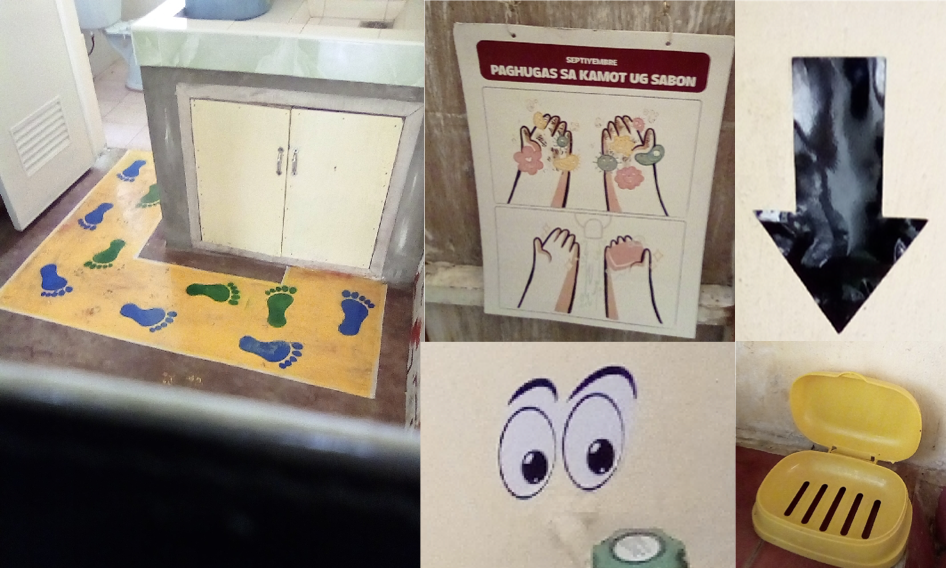
I spearheaded the design process by first creating a shortlist of nudges from the existing literature and my own creativity. Then, my team and I went out and… tested. In two weeks, after several participatory design sessions and one-day pilots, we had 6 nudges we were confident in to roll out across the province.
A rigorous mixed-methods approach but an accessible communication strategy
There were many complex stakeholders with very different demands for the research. It had to be rigorous to convince UNICEF and other researchers to further invest; practical to convince DepEd to scale; and relevant enough to convince school admins and teachers to back the campaign.
To meet all these needs, we designed a mixed-methods study. We employed a quasi-experimental design and ran a multivariate regression to rigorously show the impact. However, we also gathered thick data from students and teachers to learn about the nuanced experience of using the nudges.
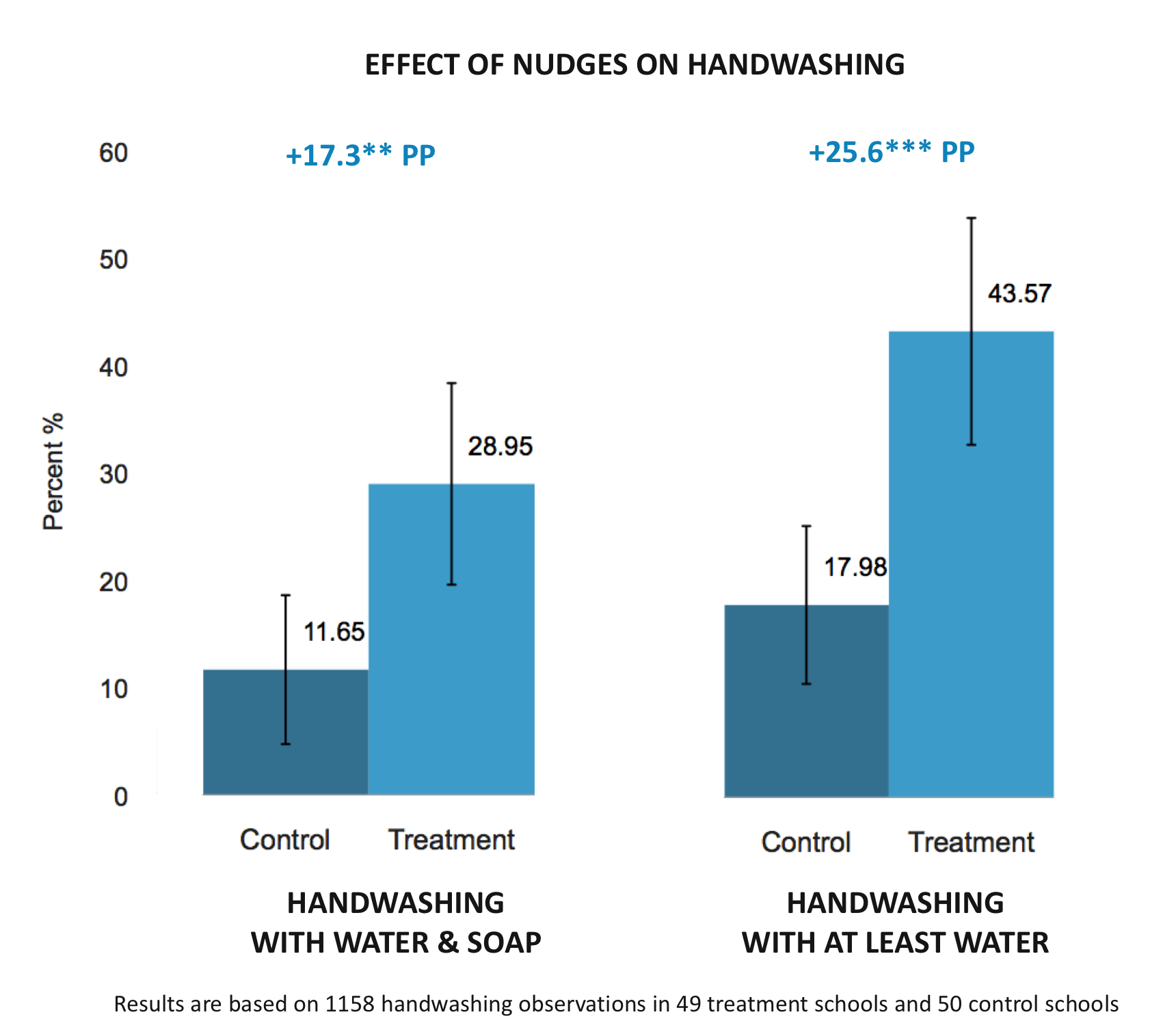
Armed with this data variety, we developed insights that explained both the why and the how, backed by multiple types of data. For example, we could state that student handwashing increased by 148%, and that students reported the whimsical colors and enjoyed handwashing more as the result.
Our data variety helped us tailor our communication of the insights to the stakeholders—rigorous impact analyses to UNICEF and its researchers, implementation guidelines to DepEd, and testimonials in the words of students and teachers to local school bodies.
Outcomes
We found that our self-designed handwashing nudges drove longer-lasting, “sticky” behavior change in handwashing among students. Based on those results, we recommended the nudges be scaled up across elementary schools in the Phillipines with minimum handwashing facilities.
We designed, implemented, and evaluated (with a randomized controlled trial) a solution that did just that. When the pandemic broke out in early 2020, our project—launched in 2019— gained new urgency and garnered national and even international attention.
After a series of high-stakes presentations, UNICEF and DepEd were so impressed by the project’s promise that they commissioned us to create additional materials to spread the word: a peer-reviewed academic paper (which I co-authored!); two blog posts; a policy brief; a self-installation guide (that got a lot of attention during the pandemic!); and even a video.
Impact
UNICEF has scaled up handwashing nudges in the Philippines as a direct result of our study. They also implemented handwashing nudges in other locations (markets, malls, health centers, etc), and recommended UNICEF commission additional studies on nudges in other countries.